Why Your Feet Go Numb on the Elliptical but Not When You Walk
Quick Answer: Elliptical foot numbness happens because your feet stay in one fixed position on the pedals with continuous pressure, which compresses nerves in the forefoot, while the absence of a heel-lift phase means the foot muscles never pump blood the way walking does. Fixes: loosen your laces, shift your weight back toward the heel, lift your heels off the pedals periodically, move your feet every few minutes, and check that the pedal position and your shoe are not squeezing the forefoot.
Fifteen minutes in, your toes start to tingle. Twenty minutes and it is the whole ball of the foot. You step off, walk five steps, and it clears completely.
Walking clears it in seconds, which tells you almost everything about what is causing it.

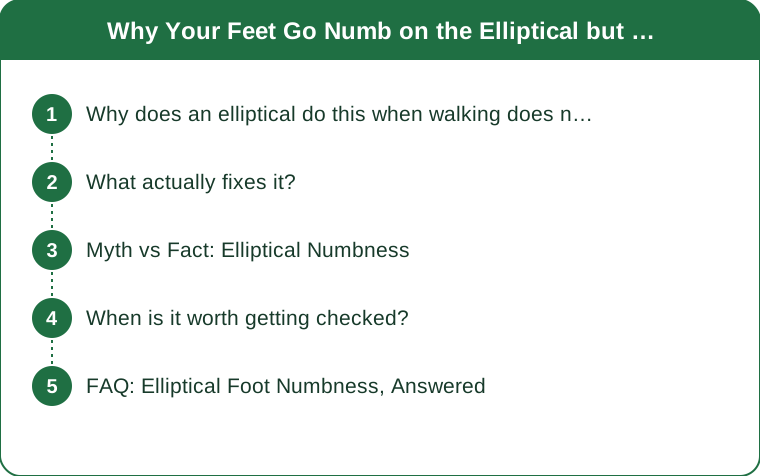
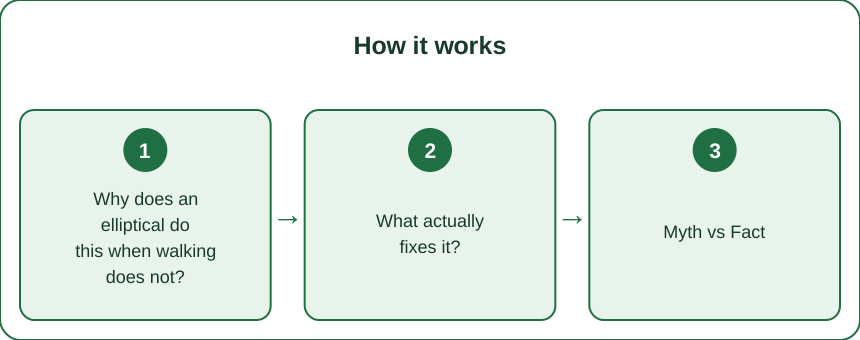
Why does an elliptical do this when walking does not?
Your feet never leave the pedals. Walking involves a repeated cycle of loading and unloading each foot, with a swing phase where there is no pressure at all. On an elliptical, both feet stay in continuous contact under continuous load for the entire session.
There is no heel-lift phase. In walking, the foot rolls through and the heel lifts, which changes where the pressure sits and works the small muscles of the foot. The elliptical stride keeps the whole foot flat, so the pressure point never moves.
Continuous pressure compresses the nerves in the forefoot. The nerves running between the metatarsal heads are close to the surface and are compressed when weight sits on the ball of the foot for long uninterrupted periods. That compression is what produces the classic burning or tingling.
The foot muscle pump goes unused. Repeated contraction of the foot and calf muscles assists blood return. When the foot stays static, that pump does not operate, and circulation to the forefoot is reduced.
Feet swell during exercise. Blood flow and warmth increase foot volume during a session, so shoes that were comfortable at the start get tighter as the workout continues - which is exactly why the symptom appears on a delay.
And weight distribution on an elliptical is often forward. Many people ride with weight over the ball of the foot, particularly when holding the handles and leaning slightly forward, which concentrates pressure precisely where the nerves are.
What actually fixes it?
Loosen your laces, particularly across the forefoot. This is the first thing to try and it resolves a large share of cases on its own. Tight lacing over the widest part of the foot restricts both nerves and blood flow.
Shift your weight toward your heels. Consciously sitting back so more pressure is through the heel takes load off the forefoot. It also tends to engage the glutes more, which is a better position anyway.
Lift your heels off the pedals every few minutes. Alternately rocking through the foot, or briefly lifting the heels, restores the movement that walking provides naturally and often clears symptoms before they build.
Move your feet on the pedals periodically. Slide them slightly forward or back every few minutes so the pressure point changes rather than staying fixed for forty minutes.
Check your shoes. A wider toe box, a size up, or a different lacing pattern that skips the eyelets over the widest point can all help. Shoes that fit a static foot may be too tight for a warm swollen one.
And take a walking break. Ninety seconds off the machine, walking normally, resets everything - and it is more effective than pushing through and hoping it passes.

Myth vs Fact: Elliptical Numbness
Myth: It means something is wrong with your circulation. Fact: transient numbness during an elliptical session that resolves quickly when you move is usually mechanical pressure rather than a circulatory problem. Numbness that persists after exercise is a different situation.
Myth: Tighter shoes give more support and will help. Fact: tighter shoes are one of the most common causes of this specific symptom. Loosening usually helps and tightening usually does not.
Myth: It is unique to cheap machines. Fact: pedal design and stride length vary, and some machines are worse than others, but the underlying cause - static feet under continuous load - is common to the design in general.
Myth: You should push through it. Fact: continuing to compress a nerve that is already signalling is not useful. Adjusting position takes a few seconds and resolves it far faster.
Myth: Thicker socks will cushion the pressure. Fact: thicker socks reduce the space inside the shoe, which usually makes forefoot compression worse rather than better.
Myth: It only affects certain foot shapes. Fact: it is very common across foot types. Wider feet and higher volume feet reach the problem faster, but nobody is immune to forty minutes of static loading.
When is it worth getting checked?
When numbness persists after you stop. Symptoms that continue for a long period after exercise, or that are present at rest, need professional assessment rather than an equipment adjustment.
When it affects only one foot consistently. A consistent one-sided pattern can point to something specific - a nerve entrapment or a structural issue in that foot - rather than a general loading problem.
When it comes with pain rather than tingling. Sharp or localised forefoot pain, particularly between the third and fourth toes, is worth having looked at rather than working around.
When it happens in shoes generally, not just on the machine. Numbness while walking, standing, or in everyday footwear is a broader pattern.
When there is any weakness or a change in balance. Loss of strength or coordination is a different category of symptom entirely.
This is general information, not medical advice. Anyone with diabetes or a known circulatory or neurological condition should discuss foot symptoms with a clinician rather than managing them with lacing adjustments.
FAQ: Elliptical Foot Numbness, Answered
Why do my feet go numb on the elliptical?
Because your feet stay in one position under continuous pressure with no swing phase or heel lift, which compresses the nerves in the forefoot and removes the muscle pump that assists circulation when walking.
How do I stop my feet going numb during cardio?
Loosen your laces across the forefoot, shift weight toward your heels, lift your heels and move your feet on the pedals every few minutes, and check that your shoes are not tight when your feet are warm and swollen.
Should I wear thicker socks?
Usually not - thicker socks reduce space inside the shoe and often make forefoot compression worse. A wider shoe or looser lacing is the more reliable fix.
Is it dangerous?
Transient numbness that clears quickly once you move is generally mechanical. Numbness that persists after exercise, affects one foot consistently, or comes with pain or weakness should be assessed by a clinician.
TL;DR:
- Elliptical numbness comes from static feet under continuous pressure with no heel-lift phase to move the load or pump blood.
- Feet swell during exercise, which is why the symptom appears on a delay rather than immediately.
- Loosen laces across the forefoot first - it resolves a large share of cases on its own.
- Shift weight toward the heels, lift the heels periodically, and move your feet on the pedals every few minutes.
- Persistent numbness after exercise, consistent one-sided symptoms, pain, or weakness warrant professional assessment.
Walking clears it in five steps because walking is the thing the machine removed.
This is general information, not medical advice.
Keep Reading
This article is for general informational and styling purposes only. Fit, sizing, and product availability may vary.