How to Set Up an Elliptical So Your Hips Stop Aching
Quick Answer: Hip ache on an elliptical usually comes from a stride length that does not match your leg length, a fixed pedal angle that forces your hips to rotate, or gripping the moving handles and letting your torso twist. Fix it in this order: reduce stride length or use a machine with adjustable stride, stand more upright with less forward lean, keep your feet flat and pointed straight ahead, and stop holding the moving handles for a few sessions to see whether your torso was rotating.
The elliptical is supposed to be the gentle option. If it is leaving one hip or both hips aching afterwards, something in the geometry does not fit you, and it is nearly always fixable in the first two minutes of the session rather than in the gym over months.

Why does an elliptical bother hips when running does not?
Because your feet never leave the pedals. In walking or running, your foot is free between steps, and your hip can find its own path. On an elliptical, the machine dictates the path, and your hip has to accommodate whatever that path is.
Stride length is fixed on most machines, and it is usually built for a person around 5 foot 9. If you are notably shorter or taller, the stride is either overreaching your hip or cramping it, for every single revolution.
Pedals are also usually fixed in the horizontal plane. Your feet are held slightly apart at a set width and a set angle, and if your natural gait turns your feet out even slightly, your hip has to rotate internally to comply.
Then there is the repetition. A 30-minute session is roughly 2,000 to 3,000 revolutions, all identical. Any small mismatch is repeated thousands of times without variation, and that is the definition of an overuse setup.
Which is why the fix is almost always geometric rather than muscular. Strengthening a hip that is being asked to move through a path it does not like does not solve the problem.
What is the right stride length for you?
Roughly: under 5 foot 3, look for an 18 inch stride. 5 foot 3 to 5 foot 7, around 20 inches. Above 5 foot 7, 20 to 22 inches. Most commercial gym machines are fixed at 20 or 21 inches.
If the stride is too long for you, your hip is being pulled into extension at the back of every revolution. This produces ache at the front of the hip, and it is the most common presentation.
If the stride is too short, your hip never fully opens and you tend to get a cramped, hip-flexor-tight feeling and a shorter, choppier motion.
On a fixed machine that is too long, shorten your effective stride deliberately. Consciously take a shorter path and do not reach for the back of the arc. It reduces the range and it will feel odd for a session, and it usually resolves the ache within a week.
Adjustable-stride machines exist and are worth seeking out if this is a persistent problem - many gyms have one or two among a row of fixed ones.
Increasing the incline shortens the effective forward reach on machines that have it, which is a useful workaround on a machine that is slightly too long for you.
What should your posture actually look like?
Upright, with your weight over the middle of your feet. The most common posture error is leaning forward onto the fixed handles, which tips the pelvis and loads the front of the hip through the entire stride.
Do not lock your knees at the front of the arc. A soft knee throughout keeps the motion in the hip and the quad rather than jamming at the joint.
Keep your feet flat and pointed straight ahead. Rising onto the toes at the back of the stroke is a sign the stride is too long. Feet turning out is a sign you are compensating for a pedal angle that does not suit you.
Shift your foot position on the pedal. Standing slightly further back on the pedals changes the hip angle noticeably, and this single adjustment fixes a surprising number of complaints. Try it for five minutes and see.
Do not grip the fixed handles hard and lean. Light contact only. If you need to hold on firmly, the resistance is too high for your current stability, not too low for your fitness.
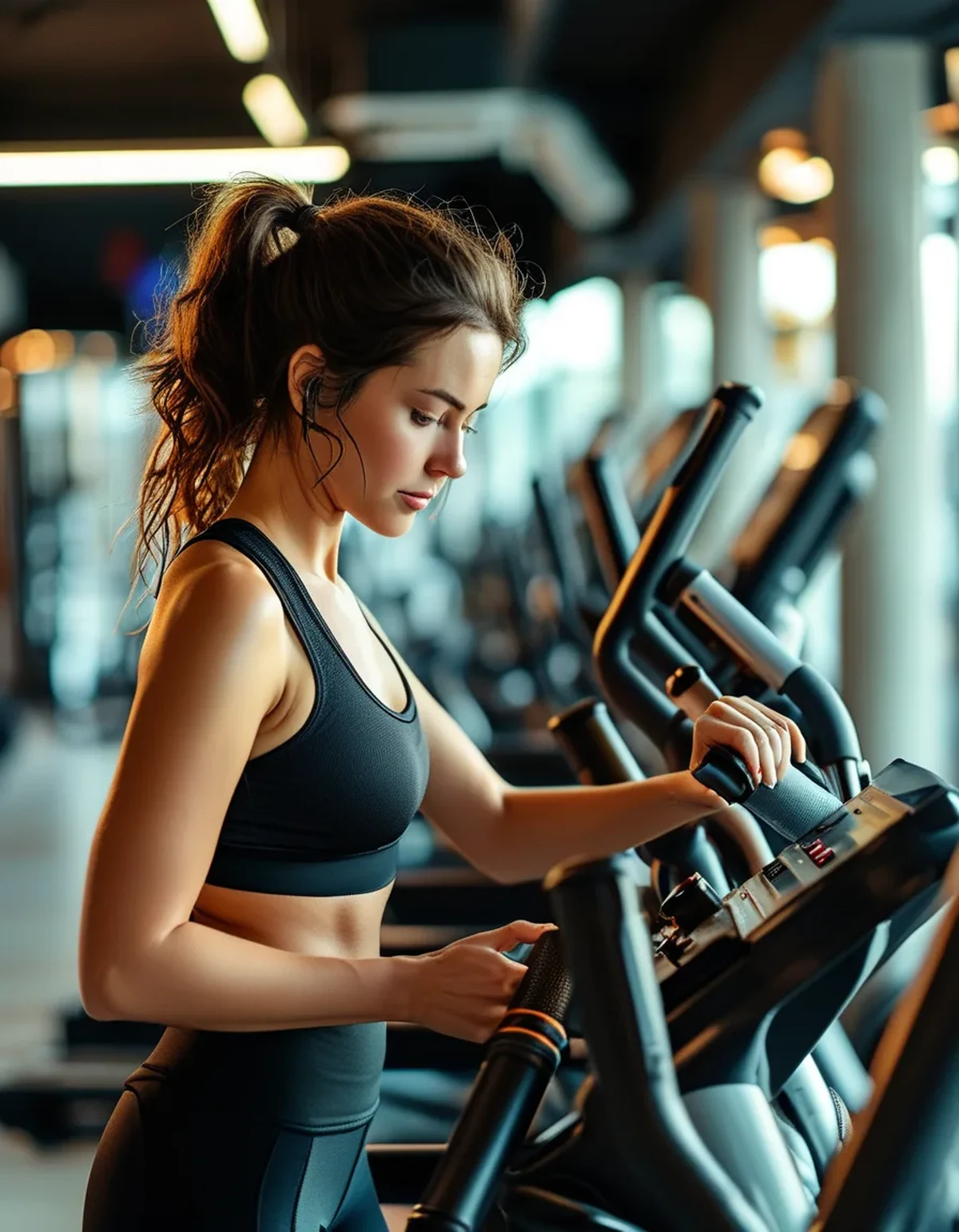
What Nobody Tells You About the Moving Handles
Most people push and pull the handles out of phase with their legs, which introduces a rotational demand on the pelvis on every stroke. This is a leading cause of one-sided hip ache on ellipticals and it is invisible to the person doing it.
The test: do three sessions with your hands off the handles entirely, arms swinging naturally or resting lightly on the fixed bars. If the hip ache reduces, the handles were the problem.
Arms should be in opposition to legs, exactly as in walking. Right arm forward with left leg forward. Many people unconsciously synchronise same-side arm and leg, which locks the torso and forces the hips to absorb the rotation.
Pulling hard with the arms reduces leg work rather than adding to it. People pulling aggressively on the handles often produce less total work than they would with a slightly higher resistance and quiet arms, while adding all the rotational load.
Alternate: five minutes hands-off, five minutes hands-on. This breaks up the identical repetition that is the underlying issue, and it is the closest thing to variability an elliptical offers.
And step off and swap direction occasionally. Pedalling backwards for a few minutes changes the hip loading pattern completely and most people never try it.
What if the setup is right and it still aches?
Check whether it is actually the hip joint or the surrounding tissue. Ache deep in the groin behaves differently from ache on the outside of the hip - the latter is more commonly gluteal tendon irritation, which responds to a reduced range and progressive strengthening rather than to machine adjustments.
Reduce volume for two weeks and reintroduce gradually. If you jumped from 15 to 45 minute sessions in September as part of a new routine, the ache may simply be volume, and the setup may be fine.
Add hip strengthening on non-elliptical days. Side-lying leg raises, glute bridges, and step-ups two or three times a week address the gluteus medius weakness that makes people sensitive to any repetitive machine.
Vary your cardio. The elliptical’s fixed path is its main drawback. Alternating with a bike, a rower, or walking removes the identical-repetition problem entirely.
See someone if there is groin pain that catches, any clicking with pain, night pain, or ache that persists for more than two or three weeks after you have corrected the setup.
This is general information, not medical advice.
FAQ: Elliptical Hip Pain, Answered
Is the elliptical bad for your hips?
No - it is low impact and well tolerated by most people. It is unusually unforgiving of a size mismatch, though, because the path is fixed and identical thousands of times per session.
Should I use incline to fix hip discomfort?
Often yes. Raising the incline shortens the effective forward reach and shifts more work to the glutes, which frequently reduces front-of-hip ache immediately. Try 5 to 10 percent higher than your usual.
How do I know if the stride is too long for me?
You will find yourself rising onto your toes at the back of the arc, or your hips will rock side to side visibly. Both mean you are reaching further than your hip comfortably travels.
This is general information, not medical advice. Persistent groin pain, pain that wakes you, or pain with clicking should be assessed professionally.
TL;DR:
- Hip ache on an elliptical is nearly always geometry: a fixed stride length that does not match your leg length.
- Under 5 foot 3 wants roughly an 18 inch stride; most gym machines are fixed at 20 or 21. On a too-long machine, deliberately shorten your path or raise the incline.
- Stand upright rather than leaning on the handles, keep feet flat and straight, and try standing slightly further back on the pedals.
- Do three sessions without touching the moving handles - out-of-phase arm work is a leading cause of one-sided hip ache and nobody notices they are doing it.
It is a two-minute fix at the console, not a six-week strengthening programme. Change the geometry first.
Keep Reading
This article is for general informational and styling purposes only. Fit, sizing, and product availability may vary.