How to Make the Elliptical Actually Hard
Quick Answer: The elliptical under-delivers because the flywheel does the work for you between strokes and your bodyweight is supported. Fix it with four changes: raise resistance and lower cadence, let go of the handles, use the incline rather than the resistance alone, and structure the session as intervals rather than a steady thirty minutes. Done properly it produces genuine cardiovascular stress with very low joint impact, which is a rare and valuable combination.
You did thirty-five minutes and barely broke a sweat, and the machine told you it was 400 calories.
Both of those things are the machine working exactly as designed.
Here is how to make it work for you instead.


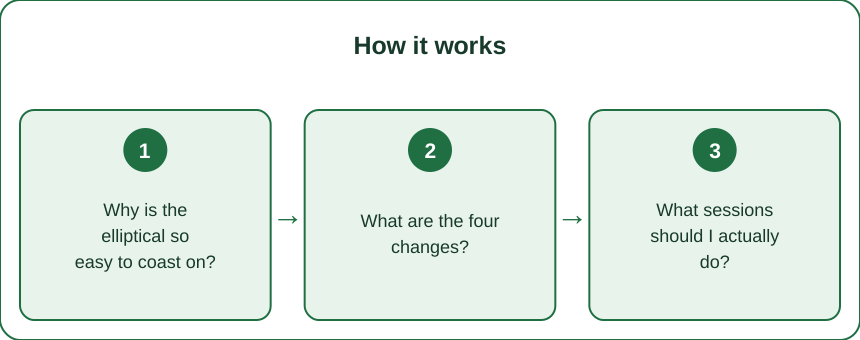
Why is the elliptical so easy to coast on?
Three design features conspire, and each is a feature rather than a fault.
Flywheel momentum. The elliptical has a heavy flywheel that, once spinning, carries the pedals through the stroke. Beyond a certain cadence, you are being carried more than you are working. This is what makes it feel smooth, and it is also what lets you do 160 strides a minute while producing very little force.
Bodyweight support. Your feet never leave the pedals, so you never accelerate your own mass upward. Running requires you to lift and lower your body every stride, which is metabolically expensive. The elliptical removes that cost entirely — which is exactly why it is joint-friendly, and exactly why the same perceived effort produces less work.
The handles. Pushing and pulling on moving handles feels like additional work, and it does involve the upper body. But it also lets you use your arms to drive the pedals, offloading the legs, and it lets you brace against the machine, further reducing lower-body demand.
Add a fourth factor: calorie displays on cardio machines are estimates based on generic formulas, and studies comparing machine readouts to measured energy expenditure have consistently found ellipticals among the least accurate, frequently over-reporting substantially.
None of this makes the machine bad. It makes it a machine that requires deliberate use.
What are the four changes?
One — raise resistance, lower cadence. The most important change. Instead of 160 strides per minute at level 5, work at 110 to 130 strides per minute at a resistance where each stroke requires real force. You should feel your legs producing effort against something, not spinning freely. This shifts the work from momentum to muscle.
Two — let go of the handles. Hands off, or resting lightly on the stationary centre post. This removes the upper-body offload, forces your legs to drive the whole stroke, and significantly increases the demand on your hips and core for stabilisation. Most people find their heart rate rises 10 to 15 beats per minute at the same settings simply by letting go.
Three — use the incline. On machines with an adjustable ramp, incline changes which muscles do the work. A low ramp emphasises the quadriceps and feels more like cycling; a high ramp emphasises glutes and hamstrings and feels more like climbing. High-ramp work at moderate cadence is substantially harder and recruits far more muscle mass.
Four — structure it as intervals. Steady-state at a comfortable effort is where the elliptical delivers least. Structured intervals — where the resistance is high enough that you genuinely want the interval to end — are where it delivers most.
Applied together these turn a thirty-minute session that felt like nothing into one that is comparable to a hard run, without the impact.
What sessions should I actually do?
Three that work, each with a different purpose.
Session one — the pyramid, 25 minutes. Five minutes easy warm-up. Then one minute hard, one minute easy; two minutes hard, one easy; three hard, one easy; two hard, one easy; one hard. Five minutes cool down. Hard means a resistance where you cannot hold a conversation and your cadence naturally drops. Hands off throughout.
Session two — the climb, 30 minutes. Five minutes warm-up at low ramp. Then every three minutes, increase the ramp by one setting while holding cadence constant, for five increases. Hold the top for three minutes. Then descend back down in three-minute steps. This is a sustained, high-muscle-mass session that builds aerobic capacity without impact.
Session three — the short hard one, 15 minutes. Three minutes warm-up. Then eight rounds of 30 seconds at the highest resistance you can maintain for 30 seconds, with 60 seconds of easy pedalling between. Three minutes cool down. This is genuinely difficult and is the session that most clearly demonstrates that the machine can be hard.
How to gauge effort without a heart rate monitor: the talk test works well. Easy means full sentences. Moderate means short sentences. Hard means single words. Very hard means you would rather not speak at all.
Frequency: two hard sessions a week is plenty alongside other training. More than that and you are borrowing from your recovery.

Myth vs Fact: the elliptical
Myth: The calorie readout is roughly accurate. Fact: Cardio machine calorie estimates are generic approximations, and ellipticals have been found to be among the least accurate, often over-reporting significantly. Use it as a relative measure between your own sessions, never as an absolute number.
Myth: Using the handles makes it a full-body workout. Fact: It does involve the upper body, but it also allows the arms to drive the legs, and most people end up doing less total work with the handles than without. If you want upper body work, do upper body work.
Myth: The elliptical is only for rehab or beginners. Fact: It is genuinely low-impact, which makes it excellent for people managing joint issues — and equally makes it an excellent way for well-trained people to add aerobic volume without adding impact load. Plenty of runners use it deliberately for exactly this.
Myth: You should aim for the highest stride rate you can manage. Fact: High cadence at low resistance is where the machine does the work. Lower cadence at higher resistance is where you do. The third myth here is the one that stops many people from using a genuinely useful machine.
Myth: It works the same muscles as running. Fact: Similar muscle groups, meaningfully different pattern. The absence of impact and of a true swing phase means it does not replace running for a runner, though it complements it well.
When is the elliptical the right choice?
Worth being clear about, because it is genuinely the best option in several situations and a mediocre one in others.
Good choice when:
- You are managing joint pain, or returning from a lower-limb injury with clearance to train
- You want aerobic volume without adding impact load to an already high-impact week
- Outdoor conditions make running unsafe — which from October onward means dark, wet, icy mornings for a lot of people
- You need to train while reading or watching something, which is a real adherence advantage
- You want to work hard without the coordination demand of a new activity
Less good choice when:
- You are training for a running event and need specific running adaptation
- You want to build bone density, which requires impact loading
- You want maximal strength or power development
- You find it so boring that you do half a session
The seasonal point: autumn is when the elliptical becomes most useful for most people, because outdoor running conditions deteriorate and gym cardio becomes the realistic default. It is worth learning to use it properly at exactly the moment you are about to spend a lot of time on one.
If you have any cardiovascular condition or are returning from injury, get individual guidance before starting interval work. This is general information, not medical advice.
FAQ: Elliptical Questions, Answered
Should I go forwards or backwards?
Forwards is the primary direction and where most of your work should be. Reverse pedalling shifts emphasis toward the hamstrings and glutes and is a reasonable variation for a few minutes, but it is less mechanically natural and not a substitute.
Why do my feet go numb?
Usually pressure on the ball of the foot from a fixed foot position with no natural roll-through. Shifting your weight slightly toward the heels, moving your feet on the pedals every few minutes, and loosening your shoes a little typically resolves it.
How does it compare to a bike or a rower for the same time?
The rower involves the most muscle mass and is the hardest per minute when done well. The bike allows the highest sustained power. The elliptical sits between them and wins on being fully weight-supported with an upright posture, which suits people who find rowing technique hard or cycling positions uncomfortable.
TL;DR:
- The elliptical is easy because flywheel momentum carries the stroke, your bodyweight is supported, and the handles let your arms offload your legs.
- Raise resistance and lower cadence to around 110 to 130 strides per minute, let go of the handles, and use the incline rather than resistance alone.
- Structure sessions as intervals — a pyramid, a climb, or eight 30-second efforts — rather than a comfortable steady thirty minutes.
- Ignore the calorie readout entirely; use it only to compare your own sessions to each other.
The elliptical has a reputation as the machine you use when you do not want to work hard, and that reputation is earned by how most people use it rather than by what it can do. Take your hands off the handles for one session and you will find out very quickly that the machine was never the limiting factor.
Keep Reading
This article is for general informational and styling purposes only. Fit, sizing, and product availability may vary.