Six Ways to Make the Elliptical Genuinely Challenging
Quick Answer: Raise resistance rather than speed, use the incline, stop holding the moving handles for part of the session, add structured intervals, and go backwards for a few minutes. The elliptical feels easy because most people run it at low resistance and high cadence, which is the least demanding combination the machine offers.
The machine has more range than almost anything else in the cardio room, and most sessions use about a fifth of it.
This is general information, not medical advice.

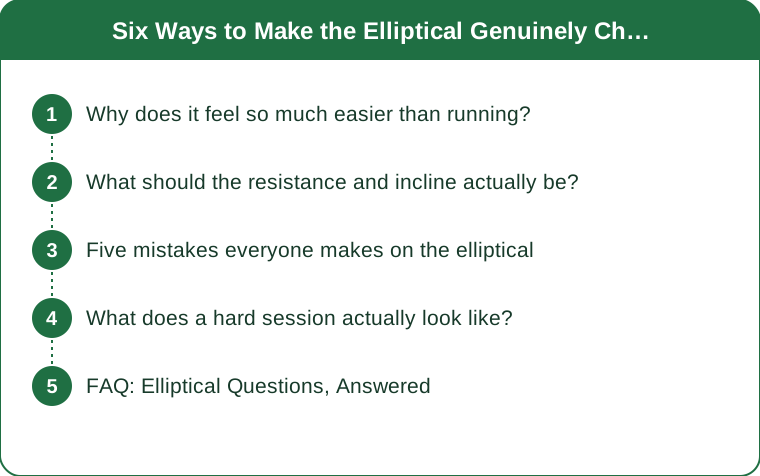
Why does it feel so much easier than running?
Three reasons, and only one of them is about the machine.
No impact means no eccentric loading. Running involves absorbing bodyweight on each landing, which is metabolically costly and causes muscle damage. The elliptical removes it entirely. That is the machine’s main benefit and also why the same perceived effort produces less total load.
The flywheel does part of the work. Once a heavy flywheel is spinning, momentum carries the pedals through part of each revolution. At low resistance and high cadence, you are largely maintaining momentum rather than generating force — and generating force is where the metabolic cost lives.
Most people self-select an easy setting. This is the biggest factor. Given a machine with twenty resistance levels, the typical user settles at four or five and pedals fast. High cadence at low resistance is the least demanding combination available, and it happens to feel busy, which is why it is comfortable.
The fix follows directly: invert it. Lower cadence, much higher resistance, and you are generating force on every stroke rather than riding momentum.
What should the resistance and incline actually be?
Specific numbers, because vague advice here produces no change.
Resistance: if you are currently at 5 out of 20 and pedalling at 70 rpm, try 12 out of 20 at 50-55 rpm. It will feel completely different — heavier, slower, and much harder. Your heart rate will be higher at the lower cadence, which is the opposite of what most people expect.
Cadence target: 50-60 rpm for strength-biased work, 60-70 for steady aerobic work. Above 80 rpm you are almost certainly riding momentum.
Incline changes which muscles work, and it is the most underused control on the machine. Low incline emphasises quadriceps and feels most like walking. High incline shifts load to glutes and hamstrings and feels dramatically harder at the same resistance. Moving from incline 1 to incline 15 at the same resistance is one of the largest intensity changes available on any cardio machine, and most users never touch it.
Change one variable at a time. Raising both resistance and incline simultaneously produces a session that ends early. Add resistance for two weeks, then start using incline.

Five mistakes everyone makes on the elliptical
1. Leaning on the handles. Supporting bodyweight through the arms removes load from the legs and drops the calorie cost substantially. It also encourages a hunched posture. Stand upright, with a light touch or no hands at all — which brings us to the next one.
2. Never letting go. Holding the moving handles and pushing with the arms is fine, but doing it for the entire session means the legs never work alone. Three minutes hands-free, with arms swinging naturally, is one of the hardest things you can do on the machine and it exposes exactly how much the arms were contributing.
3. Watching the calorie display and believing it. Elliptical calorie estimates are among the least accurate in the gym, typically overestimating substantially because the machine does not know your weight distribution, your handle use, or your effort. Use heart rate or perceived exertion instead.
4. Never going backwards. Reversing the stride shifts emphasis to hamstrings and glutes and is genuinely harder to coordinate. Two or three minutes of backwards pedalling in each session adds a stimulus the forward stride does not.
5. Riding the same programme every session. The machine has intervals, hills, and manual mode, and most people press quick start and stare at a screen for thirty minutes. The single change with the biggest effect is structure, and it costs nothing.
The second one surprises people most — hands-free elliptical is far harder than it sounds.
What does a hard session actually look like?
Two templates, each around thirty minutes.
The interval session:
- 5 minutes easy — moderate resistance, comfortable cadence.
- 8 rounds of: 1 minute at resistance 14-16, cadence 55-60, working hard; then 1 minute easy at resistance 6.
- 5 minutes easy to finish.
That is 26 minutes, and it is genuinely demanding. The key is that the hard minute uses resistance rather than cadence to create intensity.
The strength-biased session:
- 5 minutes easy.
- 4 blocks of 4 minutes, each at high resistance and 50-55 rpm, alternating incline between low and high, with 1 minute easy between blocks.
- 3 minutes hands-free at moderate resistance.
- Cool down 3 minutes.
How to know it worked: you should be breathing hard enough that speaking in full sentences is difficult during the hard portions, and you should feel it in the glutes and hamstrings rather than only in the quadriceps. If your legs feel fine and you are not out of breath, the resistance was too low regardless of what the calorie display said. This is general information, not medical advice — if you have joint or cardiac considerations, get advice specific to you.
FAQ: Elliptical Questions, Answered
Is the elliptical as good as running?
For cardiovascular fitness at matched intensity, close. For bone density and for the specific adaptations of running, no — the lack of impact is exactly what removes the bone-loading stimulus. It is an excellent option when impact is a problem and a reasonable cross-training tool when it is not.
Why do my feet go numb?
Usually pressure on the ball of the foot from a fixed foot position and constant contact. Shifting your weight toward the heels, adjusting foot position every few minutes, and loosening the shoes slightly resolves it for most people.
Does the arm movement do anything useful?
Some, if you actively push and pull rather than hold on. Passive holding contributes almost nothing and can reduce leg work. The most useful thing about the handles is the option to stop using them.
TL;DR:
- The elliptical feels easy because most users run high cadence at low resistance, which is the least demanding combination available.
- Invert it: resistance 12+ out of 20 at 50-60 rpm, and start using the incline control.
- Stop leaning on the handles, and spend three minutes per session hands-free — it is much harder than it sounds.
- Add backwards pedalling and structured intervals; ignore the calorie display entirely.
- Judge the session by breathlessness and by feeling it in the glutes and hamstrings, not by time elapsed.
The incline control is the most powerful and least-used button on the machine. This is general information, not medical advice.
Keep Reading
This article is for general informational and styling purposes only. Fit, sizing, and product availability may vary.