How to Make the Elliptical Actually Hard
Quick Answer: The elliptical feels easier than the effort you put in because momentum in the flywheel carries you through part of each stroke, and leaning on the handles transfers load off your legs. Four fixes: raise resistance rather than speed, use the incline or ramp setting which changes muscle recruitment substantially, let go of the handles or use them actively rather than leaning, and use intervals instead of steady state.
You did 40 minutes, the machine said 500 calories, and you barely broke a sweat.
The machine is not lying about the effort you produced. It is that the design lets you produce very little effort while still completing the motion.

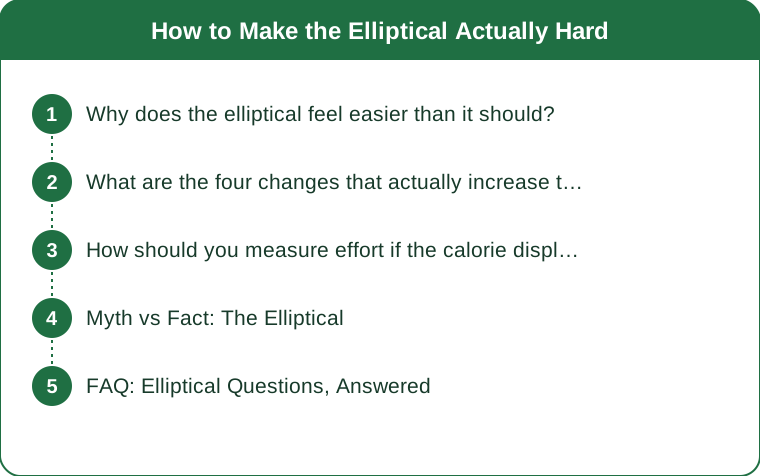
Why does the elliptical feel easier than it should?
Three design features, all of which reduce the work per stroke.
The flywheel stores momentum. Once the flywheel is spinning, it carries you through the parts of the stroke where you would otherwise have to produce force. You are topping up momentum rather than generating movement from scratch each time. On a treadmill, every step requires you to support and propel your body weight - there is no equivalent coasting.
The handles let you offload the legs. Leaning on fixed handles transfers a portion of your body weight through your arms into the frame. You are effectively unweighting yourself, which reduces the work your legs do at any given resistance.
There is no impact and no eccentric loading. Running involves absorbing your body weight on each landing - that eccentric work is metabolically expensive and is a large part of why running is hard. The elliptical eliminates it, which is exactly why it is joint-friendly, and it also removes a real component of the workload.
Then the calorie display. Machine calorie estimates are generally unreliable, and elliptical estimates tend to overestimate because they assume a level of effort the machine cannot actually measure. The machine knows resistance and cadence; it does not know how much of your weight is on the handles.
None of this makes the elliptical a poor machine. Low impact is a genuine benefit for many people. It means the default use pattern produces less work than the same time on other equipment, and the fix is to change the pattern rather than the machine.
What are the four changes that actually increase the work?
In order of effectiveness.
1. Raise resistance, not speed. The most common mistake is increasing stride rate at low resistance. Fast, light pedalling exploits the flywheel - momentum does more of the work and your legs do less.
Instead: increase resistance until you have to actively push through the whole stroke, and keep cadence moderate. You should feel your legs working through the entire rotation rather than being carried through part of it.
A useful check: if you stopped pushing, would the pedals keep moving? At appropriate resistance, they would slow quickly. If they would keep going for several strokes, the resistance is too low.
2. Use the incline or ramp. The most underused control on the machine. Raising the ramp changes the movement path and substantially shifts muscle recruitment toward the glutes and hamstrings.
A high ramp setting produces a movement much more like climbing than like the flat gliding motion, and it feels dramatically different at the same resistance. Many people never touch this setting.
3. Stop leaning on the handles. Either let go entirely - hands off, or lightly resting - or use moving handles actively to push and pull. Both increase the work; leaning decreases it.
Hands-off is also a balance and core challenge, which is a secondary benefit. Start with brief periods if you are used to holding on.
4. Use intervals. Steady state at moderate resistance is where the elliptical is easiest to coast through. Alternating hard and easy periods forces genuine effort into the hard blocks, and it is far harder to coast through a 60-second high-resistance block than through 30 continuous minutes.
A structure that works: 1 minute hard at high resistance, 2 minutes easy, repeated 8-10 times. Twenty-five minutes structured this way produces considerably more than 40 minutes of steady gliding.

How should you measure effort if the calorie display is unreliable?
Three better options, all available.
Heart rate is the most useful. A chest strap or wrist monitor gives a direct measure of cardiovascular effort that does not depend on the machine’s assumptions. The machine’s grip sensors are considerably less reliable, particularly during vigorous effort.
Rough zones: moderate intensity is commonly described as around 50-70% of maximum heart rate, vigorous above that. If you are staying under 50% for a 40-minute session, that is the objective version of the session feeling too easy.
Perceived exertion works well and requires nothing. On a 1-10 scale, moderate steady work should sit around 5-6, and interval work blocks around 7-8. A session at 3-4 throughout is a warm-up, whatever the display says.
The talk test is the simplest. Moderate intensity: you can talk in sentences but notice your breathing. Vigorous: you can manage a few words at a time. Comfortably holding a conversation with no change in breathing means the intensity is low.
On the calorie readout specifically: treat it as a rough relative measure at best. It is useful for comparing your own sessions on the same machine, and it is not a reliable absolute number - it cannot account for body composition, efficiency, or how much of your weight is on the handles.
A practical alternative: track resistance level, ramp setting and time. Those are objective machine settings, and progression in them is real progression in a way that a calorie estimate is not.
Myth vs Fact: The Elliptical
Myth: The calorie display is roughly accurate. Fact: Machine estimates are generally unreliable, and ellipticals tend to overestimate because they cannot detect how much load you are transferring to the handles.
Myth: Faster is harder. Fact: Faster at low resistance exploits the flywheel and produces less work per stroke. Higher resistance at moderate cadence is what increases effort.
Myth: Using the handles makes it a full-body workout. Fact: Only if you push and pull actively. Leaning on them transfers weight off your legs and reduces total work - the most common way an elliptical session gets easier without anyone noticing.
Myth: The elliptical is as good as running for fitness. Fact: It can produce comparable cardiovascular benefit at matched effort. It does not produce the impact loading that supports bone density, and it does not build the specific eccentric strength that running does. For joint-friendly cardiovascular training it is genuinely good.
Myth: You cannot get a hard session on one. Fact: At high resistance with a high ramp and no handle support, it is very demanding. The machine allows an easy session; it does not require one.
Myth: The ramp and resistance settings do the same thing. Fact: Resistance increases the force required; the ramp changes the movement path and which muscles do the work. They are different tools and combining them is where the machine gets genuinely hard.
FAQ: Elliptical Questions, Answered
Why do I burn fewer calories than the machine says?
The machine cannot measure how much of your body weight is supported by the handles, and its formula assumes an effort level it cannot verify. Use heart rate or perceived exertion instead, and treat the display as a rough comparison between your own sessions.
Should I hold the handles or not?
Either let go entirely or push and pull actively. What reduces the workout is resting your weight on fixed handles, which unweights your legs. Hands-off also adds a balance challenge.
What resistance level should I use?
High enough that the pedals would slow quickly if you stopped pushing. If momentum would carry them for several strokes, the resistance is too low regardless of what number is displayed.
Is the elliptical good for weight loss?
It contributes as cardiovascular exercise, and the effectiveness depends on the intensity you actually produce rather than on the machine. Diet remains the larger factor, and an easy 40-minute session contributes far less than the display suggests.
Can I use it every day?
Its low impact makes daily use more tolerable than daily running for most people. Varying intensity across the week still matters - hard every day limits recovery regardless of impact.
Elliptical or treadmill?
Treadmill for impact loading, bone density and running-specific fitness. Elliptical for joint-friendly cardiovascular work, or when managing an injury. Neither is universally better - they answer different questions.
TL;DR:
- The flywheel carries you through part of each stroke, so the default use pattern produces less work than it feels like
- Raise resistance rather than stride rate - fast and light exploits momentum
- Use the incline or ramp; it shifts recruitment toward glutes and hamstrings and is the most ignored control
- Leaning on fixed handles transfers weight off your legs; go hands-off or push and pull actively
- Intervals beat steady state here because coasting through a 60-second hard block is much harder
- Ignore the calorie display - use heart rate, perceived exertion, or the talk test
The machine lets you have an easy session. It does not make you have one.
Keep Reading
This article is for general informational and styling purposes only. Fit, sizing, and product availability may vary.