Why Stride Length Matters More Than Resistance on an Elliptical
Quick Answer: Stride length determines which muscles do the work and how much range of motion your hips and knees go through, while resistance mainly changes how hard those same muscles work. A short stride keeps you in a quad-dominant, shallow-range pattern regardless of resistance; a longer stride recruits the glutes and hamstrings meaningfully. If your elliptical has an adjustable stride, that dial changes the workout more than the resistance does.
Most people ride the same 18-inch stride for years and wonder why the machine feels one-dimensional.

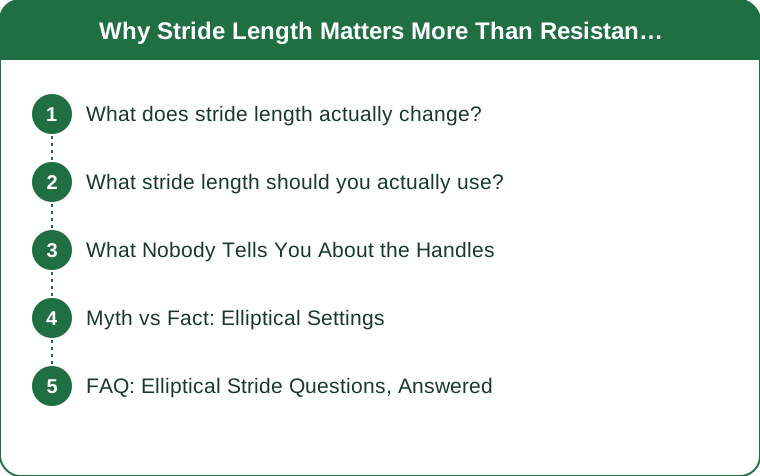
What does stride length actually change?
The joint angles you move through, which determines which muscles are loaded and how much.
On an elliptical, your foot follows a fixed elliptical path. Stride length is the long axis of that ellipse - how far forward and back your foot travels.
A short stride (roughly 16 to 18 inches) keeps hip flexion and extension in a narrow range. Movement is dominated by knee extension, which means the quadriceps do most of the work. It feels like a fast shuffle and permits high cadence.
A long stride (22 to 26 inches) takes the hip through a much larger arc. At the back of the stroke the hip approaches full extension, which is where the glutes and hamstrings contribute meaningfully. The pattern becomes more like walking or running and less like stepping.
The difference is substantial. Studies of muscle activation across stride settings show clear shifts in the relative contribution of gluteal and hamstring musculature as stride lengthens, at matched workloads.
Resistance, by contrast, mostly scales the effort of whatever pattern you are already in. More resistance on a short stride is a harder quad workout, not a different one.
This is why the elliptical gets a reputation for being one-dimensional - most people never change the variable that would make it otherwise.
What stride length should you actually use?
It depends on your height and on your goal, and there are reasonable starting points for both.
By height, a rough guide for a comfortable natural stride:
- Under 5’3”: 16 to 18 inches
- 5’3” to 5’7”: 18 to 20 inches
- 5’7” to 5’11”: 20 to 22 inches
- Over 5’11”: 22 inches and up
That is the comfortable default. Deliberately going longer than your default is where the training value is, provided you can maintain the pattern without your hips rocking side to side.
By goal:
- Glute and hamstring emphasis: longest stride you can control, moderate resistance, moderate cadence. Push through the heel and think about driving the foot backward rather than downward.
- Cardiovascular intervals: shorter stride, higher cadence. Easier to reach and hold a high heart rate.
- Joint-friendly steady state: mid-range stride, low to moderate resistance, comfortable cadence.
The useful practice is varying it within a session - four minutes long, two minutes short, repeated. That produces a genuinely different stimulus than thirty minutes at one setting, and it is the fastest way to make the machine less monotonous.

What Nobody Tells You About the Handles
Whether you hold the moving handles changes the lower-body workload more than most people assume.
When you push and pull the moving arms, the upper body contributes real work to driving the flywheel. That reduces the load on the legs at any given resistance setting - sometimes substantially. The console reads the same wattage, but a meaningful portion of it is coming from your arms.
So if your goal is lower-body work, letting go of the moving handles increases the leg stimulus without changing any setting. Holding the static center post lightly for balance is the standard way to do it.
The reverse also matters: if your goal is total-body calorie expenditure, using the arms recruits more total muscle mass and raises energy cost for the same perceived leg effort. Both are legitimate; the mistake is not knowing which you are doing.
The worst version is leaning heavily on the static handles, which unloads your body weight through your arms and reduces the work substantially while the console still shows the same numbers. If your forearms are tired after an elliptical session, you were probably leaning.
A simple check: take your hands off entirely for thirty seconds. If your effort rises noticeably at the same resistance and cadence, you were getting more help from your arms than you realized.
Myth vs Fact: Elliptical Settings
Myth: Higher resistance always means a harder workout.
Fact: Higher resistance at a lower cadence can be easier metabolically than moderate resistance at a high cadence. Power output is resistance multiplied by speed, and people often drop cadence when they raise resistance, leaving total work unchanged or lower. Watch the wattage rather than the resistance number.
Myth: Pedaling backward works completely different muscles.
Fact: It shifts emphasis somewhat toward the hamstrings and calves and is a useful variation, but the difference is more modest than commonly claimed. It is worth doing for variety and for the different coordination demand rather than as a targeted exercise.
Myth: The elliptical burns fewer calories than the treadmill.
Fact: At matched heart rate and duration, energy expenditure is broadly comparable. The perception gap comes from ellipticals often being used at lower relative intensity, and from console estimates being generous on both machines.
Myth: Incline and stride length are the same adjustment.
Fact: Distinct. Incline changes the height of the elliptical path, shifting emphasis toward glutes and calves at higher settings. Stride changes the length. Machines with both give you meaningfully more variation, and combining a high incline with a long stride is the most glute-dominant setting available.
FAQ: Elliptical Stride Questions, Answered
My machine has a fixed stride. What can I do?
Incline is your next best variable - raising it shifts emphasis toward the posterior chain in a similar direction. Letting go of the moving handles and varying cadence also help. Fixed-stride machines are usually set around 20 inches, which suits average heights reasonably.
Should my heel lift off the pedal?
Some heel lift is normal at longer strides, but if your heel is coming up substantially every stroke, the stride may be longer than your current hip mobility supports. Shorten it slightly, or work on hip flexor and hamstring mobility separately.
Is a longer stride harder on the knees?
Generally no - longer strides tend to reduce knee flexion under load compared to short choppy strides, which some people find gentler. If a longer stride produces hip discomfort, that is more likely a mobility limit than a joint problem. This is general information, not medical advice.
TL;DR:
- Stride length determines which muscles work; resistance mostly scales how hard the same pattern is.
- Short strides are quad-dominant and high-cadence; long strides bring the glutes and hamstrings in through greater hip extension.
- Use your height as a default, then deliberately go longer than default for posterior chain work.
- Letting go of the moving handles increases leg load without changing any setting; leaning on the static handles quietly reduces the whole workout.
- Vary stride within a session - four minutes long, two short - for a genuinely different stimulus.
If your machine has an adjustable stride and you have never touched it, that dial is the most underused setting in the gym. This is general information, not medical advice.
Keep Reading
This article is for general informational and styling purposes only. Fit, sizing, and product availability may vary.