Elliptical Resistance vs. Incline: Which One Actually Burns More Calories?
Quick Answer: Incline generally engages your glutes and hamstrings more and tends to raise heart rate faster, while resistance builds more quad and calf effort at a steadier pace — combining moderate levels of both typically burns more total calories than maxing out either one alone.
Most people default to whichever dial is easier to reach, not whichever actually matches their goal. The difference between the two settings is bigger than it looks.

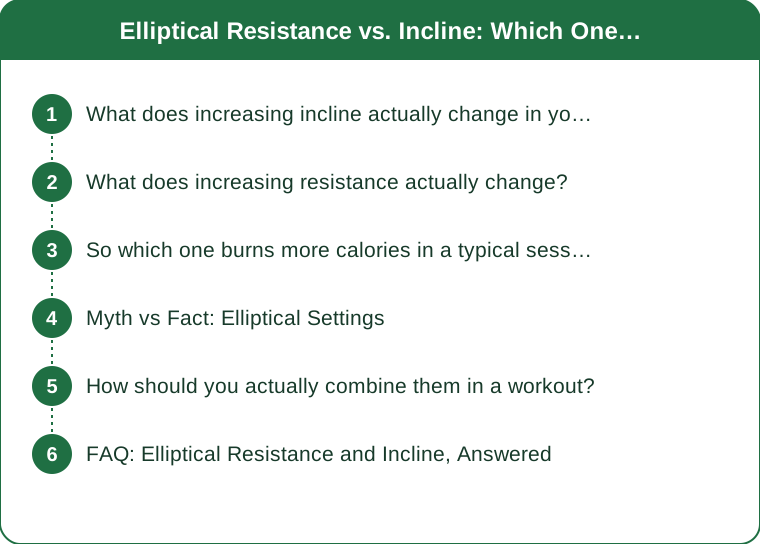
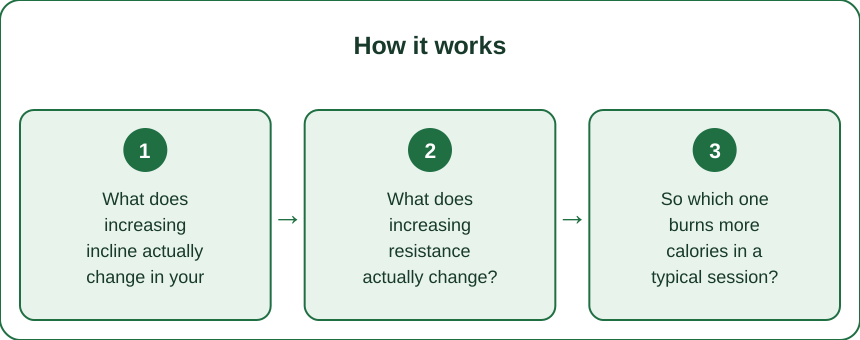
What does increasing incline actually change in your workout?
Raising incline shifts the elliptical’s motion to more closely mimic climbing a hill or stairs, which recruits your glutes and hamstrings more heavily than a flat stride. Heart rate tends to climb faster on high incline even without adding resistance, because your body is working against a steeper effective gradient.
What does increasing resistance actually change?
Resistance adds mechanical drag to the pedal motion itself, similar to pedaling a bike uphill in a heavier gear. This loads your quads and calves more directly and tends to build strength-endurance rather than spiking heart rate as sharply as incline does.
So which one burns more calories in a typical session?
For raw calorie burn, moderate-to-high incline combined with moderate resistance tends to outperform either extreme alone, since it recruits more total muscle mass (glutes, hamstrings, quads, calves) while maintaining a heart-rate-elevating pace. Maxing resistance alone with flat incline often just slows your cadence without proportionally raising calorie burn.

Myth vs Fact: Elliptical Settings
Myth: Higher resistance always means a harder, better workout. Fact: Extremely high resistance often just forces very slow cadence, which can burn fewer total calories than a faster pace at moderate resistance.
Myth: Incline only matters for leg shape, not calorie burn. Fact: Incline meaningfully raises heart rate and total-body effort, directly affecting calorie burn, not just muscle emphasis.
How should you actually combine them in a workout?
A practical approach is alternating blocks — a few minutes at higher incline with lower resistance for a cardio-focused segment, followed by a few minutes of higher resistance with lower incline for a strength-focused segment. This interval-style combination tends to be both more effective and less monotonous than one static setting for 30 minutes straight.
FAQ: Elliptical Resistance and Incline, Answered
Should beginners start with incline or resistance?
Moderate incline is usually more approachable for beginners since it raises effort without requiring much lower-body strength adjustment.
Does higher incline reduce impact on joints compared to resistance?
Both are low-impact on an elliptical, but very high resistance at low cadence can add joint strain similar to pushing too heavy a gear on a bike.
Can you get a full workout using only incline, no resistance?
Yes, incline alone at a good cadence provides a solid cardio workout, though adding some resistance helps build more lower-body strength over time.
TL;DR:
- Incline emphasizes glutes/hamstrings and raises heart rate faster
- Resistance builds quad and calf strength-endurance at a steadier pace
- Moderate levels of both together typically burn more than maxing either alone
- Alternating incline-focused and resistance-focused blocks keeps workouts effective and varied
Next session, try splitting your time between the two settings instead of parking the dial on just one.
Keep Reading
This article is for general informational and styling purposes only. Fit, sizing, and product availability may vary.