Elliptical Machines and Apartment Living: The Noise Problem Nobody Mentions
Quick Answer: Most elliptical noise in apartments isn’t the machine’s motor — since many models have no motor at all — it’s structure-borne vibration transmitted through the floor to the unit below, which a rubber mat under the machine solves far more effectively than trying to buy a ‘quieter’ model.
If a neighbor has complained, the fix is almost always about vibration isolation, not the elliptical itself.

Why do ellipticals cause noise complaints if they don’t have a loud motor?
Most consumer ellipticals are self-powered by the user’s motion rather than an electric motor, so the sound that travels to a downstairs neighbor is mostly low-frequency vibration through the floor — footfall impact and the rhythmic mechanical motion of the flywheel — not airborne noise you’d notice standing next to it.
This is exactly why an elliptical can feel nearly silent to the person using it while still generating a noticeable rhythmic thump one floor down, since vibration travels through building structure far more efficiently than sound travels through air.
Does a heavier flywheel make an elliptical noisier or quieter?
Somewhat counterintuitively, a heavier flywheel with a magnetic resistance system tends to produce a smoother, more consistent motion with less mechanical clunk than a lighter flywheel, which can actually reduce vibration noise despite the machine itself being heavier.
Budget ellipticals with lighter flywheels and belt-based resistance are more likely to have small mechanical inconsistencies that translate into audible clunks and higher-frequency vibration, which travels differently through a floor than a smooth, heavy flywheel’s motion does.
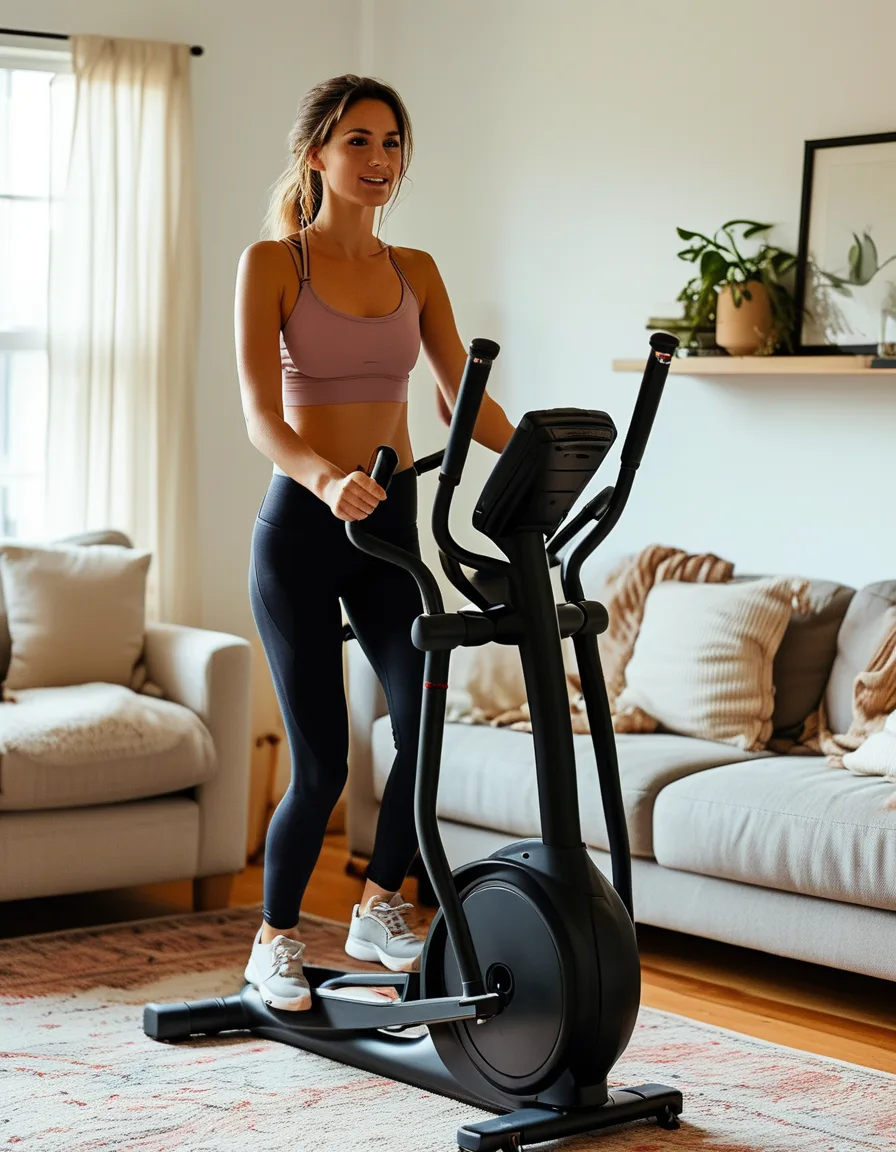
What actually reduces elliptical noise for people below you?
A dense rubber exercise mat placed under the entire machine — not a thin yoga mat — is the single most effective fix, since it absorbs vibration at the source before it transmits into the floor structure, and most users report a noticeable difference within the first use.
Positioning the elliptical against an exterior wall rather than directly over a neighbor’s living space, when floor plan allows, also reduces the practical impact even without changing the noise itself.
5 Mistakes People Make Trying to Quiet an Elliptical
Mistake 1: Using a thin yoga mat instead of a dense rubber mat. Yoga mats don’t have the mass or density to absorb meaningful vibration.
Mistake 2: Skipping regular lubrication of moving parts. A dry, under-maintained elliptical develops mechanical squeaks and clunks that add noise independent of vibration.
Mistake 3: Not tightening loose bolts periodically. Vibration loosens hardware over time, and loose parts rattle audibly, adding noise beyond the baseline.
Mistake 4: Working out at very early or late hours regardless of noise level. Even a well-mitigated elliptical carries some vibration, and timing matters as much as equipment for neighbor relations.
Mistake 5: Assuming a ‘quiet’ marketing label means vibration-free. Quiet ratings typically measure airborne motor sound, not the structural vibration that actually causes apartment complaints.
FAQ: Elliptical Noise in Apartments, Answered
Do anti-vibration pads actually work, or is it marketing?
Dedicated anti-vibration pads, made of denser rubber-cork composite than standard exercise mats, do measurably reduce structure-borne vibration in independent testing, though results vary by building construction.
Is a treadmill or elliptical worse for downstairs neighbors?
Treadmills are generally worse due to repeated footfall impact plus motor vibration, while a well-mitigated elliptical with a smooth flywheel motion tends to transmit less noise overall.
Should I tell my downstairs neighbor before starting elliptical workouts?
It’s a reasonable courtesy, especially in older buildings — a quick heads-up plus asking about timing preferences prevents most noise-related conflicts before they start.
TL;DR:
- Elliptical noise complaints are mostly about vibration through the floor, not motor sound
- Heavier flywheels with magnetic resistance often vibrate less than lighter, belt-based ones
- A dense rubber mat under the whole machine is the most effective single fix
- Regular maintenance (lubrication, tightening bolts) prevents added mechanical noise over time
Keep Reading
This article is for general informational and styling purposes only. Fit, sizing, and product availability may vary.