Is the Elliptical Actually Easier on Your Knees Than a Treadmill? What the Evidence Shows
Quick Answer: The elliptical’s knee-friendliness comes from its fixed, guided foot path that eliminates the ground-impact force present in every treadmill running or walking stride — this genuinely reduces joint loading forces on the knees compared to running specifically, but the advantage over treadmill walking (rather than running) is considerably smaller, since walking itself already has much lower impact forces than running.
The elliptical’s biggest knee-friendly advantage is specifically over running or jogging, not necessarily over a treadmill used at a walking pace.

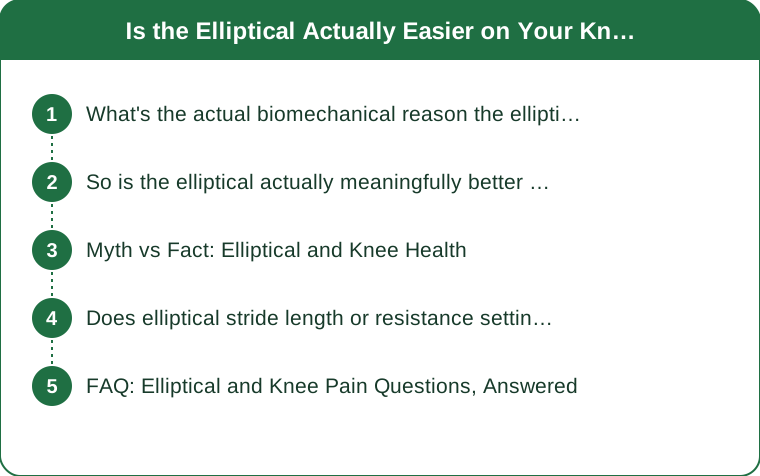
What’s the actual biomechanical reason the elliptical reduces knee stress?
The elliptical’s pedals move along a fixed, continuous elliptical path that keeps feet in constant contact with the pedal, eliminating the impact force generated every time a foot strikes the ground during running or even brisk walking on a treadmill or outdoors.
This impact force, which can be multiple times body weight with each running stride, is the primary source of the cumulative joint stress that running-related knee pain is often attributed to, and removing it is the core mechanism behind the elliptical’s reduced-impact reputation.
So is the elliptical actually meaningfully better than treadmill walking specifically, not just running?
The gap is much smaller here — treadmill walking already has relatively low impact forces compared to running, so the elliptical’s advantage over walking specifically is less dramatic than its advantage over running, though the elliptical still generally produces somewhat lower joint loading even compared to walking, due to the complete elimination of ground impact.
For someone with existing knee sensitivity specifically triggered by running or jogging, switching to either elliptical or treadmill walking would likely provide meaningful relief, with the elliptical offering a modest additional benefit over walking rather than a dramatic one.

Myth vs Fact: Elliptical and Knee Health
Myth: The elliptical eliminates knee stress entirely, making it appropriate for any knee condition. Fact: It reduces impact-related stress significantly but doesn’t eliminate all joint loading, and certain conditions still warrant caution or a doctor’s input.
Myth: The elliptical is dramatically better for knees than treadmill walking. Fact: The gap between elliptical and walking is considerably smaller than the gap between elliptical and running.
Myth: If the elliptical is low-impact, resistance level doesn’t matter for knee stress. Fact: Higher resistance settings increase muscular and joint loading even without ground impact, so resistance level still matters for someone managing knee sensitivity.
Does elliptical stride length or resistance setting affect knee stress specifically?
Yes — an improperly long stride length for your height, or excessively high resistance, can both increase knee joint stress even on a fundamentally low-impact machine, meaning the elliptical’s low-impact reputation doesn’t mean any setting or usage pattern is automatically knee-safe.
Adjusting stride length to match your natural gait (many machines have adjustable stride length) and starting with moderate resistance, particularly for anyone specifically managing existing knee discomfort, are practical steps that meaningfully affect how knee-friendly an elliptical session actually is in practice.

FAQ: Elliptical and Knee Pain Questions, Answered
Should someone with an existing knee injury use the elliptical without checking with a doctor first?
It’s generally advisable to check with a doctor or physical therapist for a specific existing injury, since the appropriate cardio option can vary considerably based on the specific condition and healing stage.
Does using the elliptical in reverse mode change the knee-stress profile?
Reverse mode changes which specific muscles are emphasized (more hamstring and glute focus) and can feel different, though it doesn’t fundamentally change the impact-elimination benefit compared to forward mode.
Is the elliptical a good option for someone recovering from a running-related knee injury?
It’s commonly recommended as a lower-impact cardio option during running-injury recovery, though the specific appropriateness and timing should still be guided by a doctor or physical therapist given the specific injury.
TL;DR:
- The elliptical’s low-impact benefit comes from eliminating ground-strike force present in running and walking
- The knee-friendly advantage over running is substantial; the advantage over treadmill walking is more modest
- Stride length and resistance setting still meaningfully affect knee stress even on a low-impact machine
- Existing knee injuries still warrant a doctor’s input before choosing elliptical over other cardio options
The elliptical’s reputation is well-earned, but the size of its advantage depends specifically on what you’re comparing it against. This is general information, not medical advice.
Keep Reading
This article is for general informational and styling purposes only. Fit, sizing, and product availability may vary.