Elliptical Incline vs Resistance: What Each Setting Actually Changes
Quick Answer: Resistance controls how hard each stride pushes back - it is the strength dial, loading your muscles more per stroke and dropping your natural cadence. Incline changes the shape of the pedal path - it is the emphasis dial, tilting the work toward glutes and hamstrings as the ramp rises and toward quads as it lowers. Resistance decides how hard; incline decides where you feel it. Used together deliberately - rolling hills, low-cadence strength pushes, easy steady state - they turn one machine into three different workouts.
The elliptical’s two adjustment dials might be the most ignored buttons in the gym. Most riders find a comfortable nothing - resistance five, incline wherever the last person left it - and ride that identical stride for years, then conclude the machine is boring. The machine was never boring; it was unadjusted. The two dials do genuinely different things to your body, and twenty minutes of understanding them upgrades every session you will ever do on one.

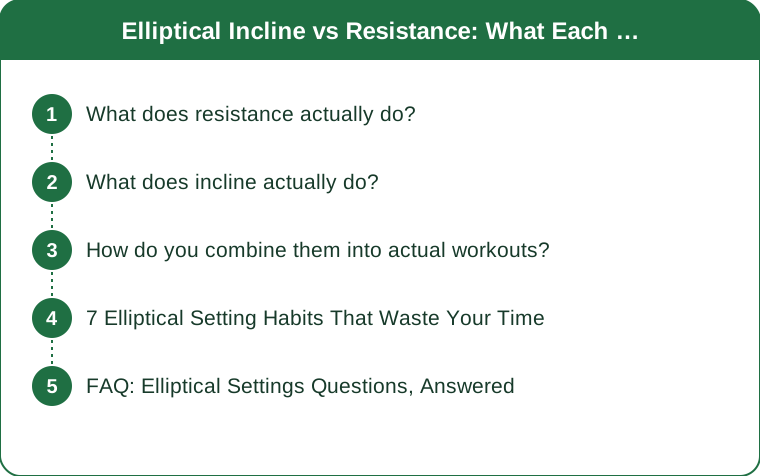
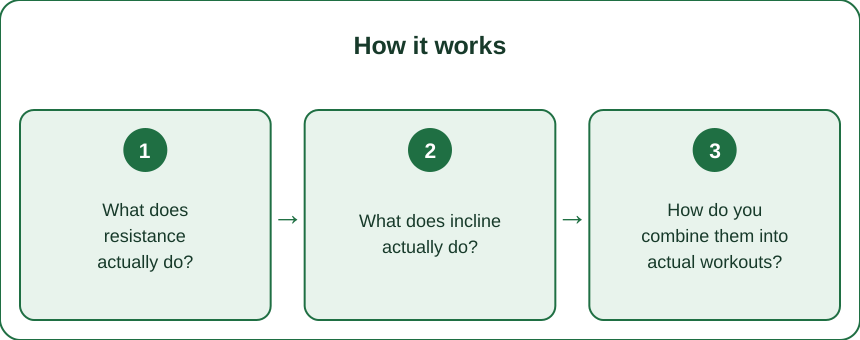
What does resistance actually do?
Resistance is the braking force on the flywheel - and everything that follows comes from that one fact.
It sets the muscular cost of every stride. Higher resistance means the pedals push back harder, demanding more force from quads, glutes, hamstrings, and calves on each stroke. Low resistance is a fast-spin cardio ride; high resistance approaches a moving leg press. The machine does not change what it is - it changes what each stride costs, which changes which energy systems and muscle qualities you are training.
It drops your cadence naturally - and cadence is the tell. At light resistance, most riders spin comfortably fast; crank the dial and stride rate falls as each stroke gets heavier. This inverse relationship is the honest readout of the setting: if you raised the resistance and your cadence did not drop, you probably let momentum take over - the flywheel is doing the work and you are along for the ride. Watching cadence keeps the setting honest.
The training translation: low resistance at moderate-to-quick cadence trains aerobic endurance - conversational, sustainable, the base-building zone. High resistance at deliberately low cadence trains strength-endurance - the legs-burning, heart-steady effort that transfers to hills, stairs, and stronger cycling. The middle is where most steady workouts should live: enough load that each stride means something, enough speed that the heart gets its session.
Two form notes that matter most as resistance climbs: push through the whole foot rather than the toes - toe-jamming at high resistance is where numb feet come from - and keep your weight on your legs, not your locked-out arms. The death-grip lean is how riders fake high resistance while their legs subcontract the work to the handrails; lighten the hands and the true cost of the setting reappears immediately.
What does incline actually do?
Incline is the misunderstood one - it is not pretend-uphill so much as a reshaping of the movement itself.
It changes the pedal path, which changes the muscle emphasis. Raising the ramp steepens the ellipse your feet travel, lengthening the climbing portion of the stroke. The practical effect, and you can feel it within thirty seconds: higher inclines shift work toward the glutes and hamstrings - the pushing-up-stairs muscles - while lower inclines flatten the path and keep the emphasis in the quads. Neither is better; they are different addresses for the effort, and rotating addresses is how one machine trains a whole lower body.
It changes stride feel and length. Low incline rides long and glide-y, closest to cross-country skiing; high incline rides shorter and steppier, closer to a stair climb. This matters for comfort as much as training: riders with cranky knees often find a sweet-spot incline where the pedal path matches their happiest joint angles - and that sweet spot is personal, found by nudging the ramp two levels at a time across a few sessions rather than looked up anywhere.
It adds cost, but gently. Raising incline does increase effort at the same resistance and cadence - climbing is climbing - but its main identity is emphasis, not intensity. If you want the workout harder, resistance is the stronger lever; if you want it to hit differently, incline is the only lever.
The pairing logic follows naturally: high incline plus moderate resistance is the glute-and-hamstring builder - the setting combination most riders have never once tried and the one that fixes the elliptical never works my glutes complaint. Low incline plus higher resistance is the quad-forward power stroke. Moderate everything is the all-day aerobic ride. Same machine, three different lower-body sessions - which is exactly what the recipes in the next section exploit.

How do you combine them into actual workouts?
Three recipes cover the training week. All assume a five-minute easy warm-up and a light hand on the rails.
Recipe 1: Rolling hills - the interesting steady workout, 30 minutes. Alternate five-minute blocks: moderate resistance at low incline, then drop resistance a notch and raise incline several levels, and repeat. The terrain changes keep cadence and muscle emphasis moving - quads on the flats, glutes on the climbs - which is precisely what makes outdoor routes feel easier than gym sessions of identical effort. This is the antidote to elliptical boredom, and the manual buttons beat the preset program because you learn what each combination feels like.
Recipe 2: The strength push day - low cadence, high resistance, 25 minutes. After warming up: eight rounds of 90 seconds at high resistance and deliberately slow, powerful strides - think stair-climb effort, whole-foot pressure, hips doing obvious work at a raised incline - followed by 90 seconds easy spinning at light resistance and low incline. Heart rate stays moderate while the legs accumulate genuine strength-endurance work; this is the session that transfers to hills and heavy shopping trips, and the one that makes high-waisted leggings with a real waistband earn their keep - nothing exposes a rolling waistband like powerful hip drive.
Recipe 3: The zone-2 base ride - conversation pace, 40-plus minutes. Moderate-low resistance, your comfortable incline, cadence steady, effort at genuinely-could-chat level. No heroics - this is the aerobic base session that most cardio weeks under-include, and the elliptical’s zero-impact nature makes it the perfect home for it: high frequency, no joint bill. Podcast-compatible by design.
Across all three, the honesty checks: cadence should match the recipe (fast means light, slow means heavy), your feet should stay full-contact, and the handrails are for balance fingertips, not weight-bearing. If the console’s effort numbers jump while your breathing does not, the flywheel is coasting and a resistance nudge is due. And rotate the recipes rather than repeating one - the machine’s whole gift is that two dials make it three machines.
7 Elliptical Setting Habits That Waste Your Time
1. Riding level five forever. The comfortable-default setting, unchanged for years, trains exactly one narrow stimulus and then stops improving anything - the adaptation happened months ago. The fix costs one button press per session: change something, anything, on a schedule.
2. The handrail death-grip lean. Weight on locked arms unloads the legs, deletes the balance work, and can cut the true effort dramatically while the console keeps flattering you. Fingertips for balance only - if you cannot, the resistance or incline is set beyond today’s honest capacity.
3. Ego-maxing both dials at once. Max resistance plus max incline produces a grinding, form-collapsing crawl that trains mostly frustration. The dials are levers to alternate, not a scoreboard to peg - high on one, moderate on the other, is where the productive hard sessions live.
4. Ignoring cadence entirely. Stride rate is the machine’s most honest gauge and most consoles display it. Coasting fast at light resistance feels productive and often is not; grinding slow without meaning to signals the setting outran you. Glance at it the way drivers glance at the speedometer.
5. Trusting the calorie screen. Console calorie counts run famously optimistic - wrong body assumptions, generous algorithms, and no knowledge of your handrail habits. Use time, settings, and effort as the progress metrics; treat the calorie number as entertainment.
6. Never pedaling with intent backward or forward through the incline range. Not the backward-pedaling debate - simply this: riders find one incline on day one and never tour the range. The two-minute tour - stepping the ramp through its levels once - is how you find both your glute setting and your happy-knees setting, and almost nobody has done it.
7. Dismounting at full spin. Stopping by leaping off while the flywheel turns is the machine’s most common minor-injury moment. Spin down, let the pedals settle, then step off - the workout’s last rep is the boring one.
FAQ: Elliptical Settings Questions, Answered
Which burns more calories - raising incline or resistance?
Whichever raises your actual effort more - and for most riders that is resistance, since it directly increases the cost of every stride, while incline mainly redirects emphasis with a modest cost increase. The honest metric is your breathing and heart rate, not the dial: the setting combination you can sustain at a genuinely elevated effort for the full session beats any theoretically superior one you abandon at minute twelve.
Is high resistance bad for knees?
Generally no - the elliptical’s fixed, impact-free path is among the most joint-friendly cardio options, and higher resistance often feels better than fast light spinning for cranky knees because cadence drops. The two knee-relevant adjustments worth making: find your comfortable incline (pedal path angle matters more to knees than resistance), and keep whole-foot pressure. Pain that persists across settings is information for a professional, not a dial. General information, not medical advice.
What cadence should I aim for?
Roughly: brisk and comfortable for aerobic rides, deliberately slow and powerful for strength pushes, and never so fast the flywheel is carrying you. If the console shows strides per minute, most steady riding lands comfortably in the middle of the machine’s readable range - but the transferable rule is matching cadence to intent, then letting resistance make that cadence honest.
Do the moving handles matter?
Modestly - actively pushing and pulling them adds upper-body involvement and raises total effort a real but small amount, while resting on them subtracts a large amount. The practical pattern: use them actively during easy rides for the full-body rhythm, and let go entirely for a few minutes each session, because the hands-free interval trains balance and forces the legs to own the true workload.
TL;DR:
- Resistance is the how-hard dial: more force per stride, lower cadence, the strength lever.
- Incline is the where dial: higher shifts emphasis to glutes and hamstrings, lower keeps it in the quads.
- Three recipes cover the week: rolling hills, low-cadence strength pushes, and long conversational base rides.
- Cadence is the honesty gauge; the handrails are for fingertips; the calorie screen is fiction.
- Tour the incline range once to find your glute setting and your happy-knee setting - almost nobody ever has.
The elliptical was never one machine - it is a small fleet wearing one frame, and the two dials are the keys. Ride it three different ways a week, and boring never comes up again.
Keep Reading
This article is for general informational and styling purposes only. Fit, sizing, and product availability may vary.