Why Your Heart Rate Reads Higher on the Elliptical Than the Treadmill at the Same Effort
Quick Answer: Three things drive it. The elliptical uses your arms as well as your legs, and upper body work raises heart rate more per unit of oxygen consumed. Grip-based handle sensors are unreliable and often read high. And unfamiliar movement patterns are metabolically less efficient, so the same perceived effort genuinely costs more early on. Only the third fades with practice.
Which means a higher number is not automatically a better workout - it may just be a less efficient one, or a worse sensor.

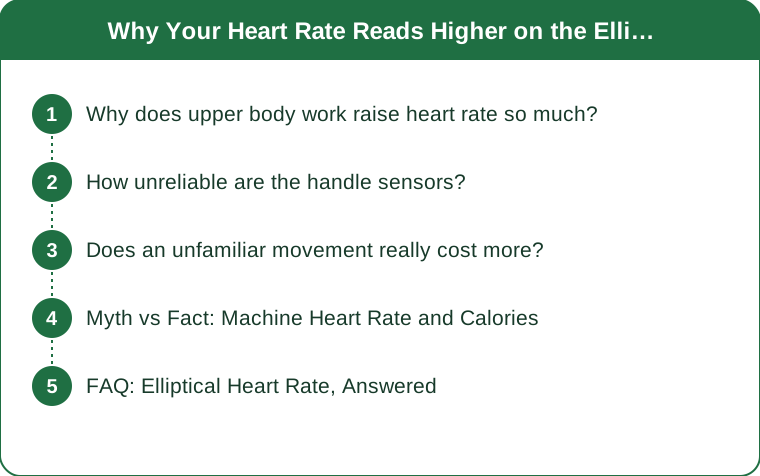
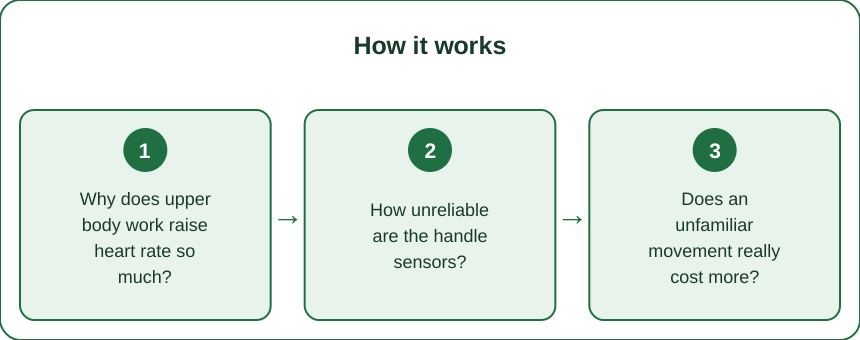
Why does upper body work raise heart rate so much?
Because arm muscles are smaller and less efficiently supplied, so the heart works harder for less oxygen delivered.
The physiological reason. For the same oxygen consumption, arm exercise produces a higher heart rate and higher blood pressure than leg exercise. This is a well-established finding and it holds across fitness levels.
Why:
- Smaller muscle mass in the arms means a higher relative intensity for the same absolute work
- Greater peripheral resistance, since a smaller vascular bed is receiving the blood flow
- More isometric holding - gripping and stabilizing raise heart rate and blood pressure independently of the movement itself
- A greater sympathetic response to upper body work generally
What this means on an elliptical. Using the moving handles engages the arms, shoulders and upper back alongside the legs. Your heart rate can be 5 to 15 beats higher than a treadmill session at the same oxygen cost, and the number is genuine rather than an artifact.
But here is the important part. Higher heart rate does not mean more calories burned or more aerobic benefit. Heart rate is a marker of cardiovascular strain, not of energy expenditure, and the two diverge specifically when upper body work is involved.
A practical demonstration. Use the elliptical for five minutes holding the fixed handles with no arm drive, then five minutes actively pushing and pulling the moving handles at the same leg cadence and resistance. The heart rate difference is usually obvious and immediate, while the leg work has not changed at all.
Which explains one of the most common confusions in the gym: two people at the same heart rate on different machines are not necessarily working equally hard.
How unreliable are the handle sensors?
Unreliable enough that they are the most likely explanation for a strange reading.
How they work. Metal contact plates detect the electrical signal of your heartbeat through the skin of your palms. The signal is very small and the detection depends on consistent skin contact and moisture.
Why they fail:
- Grip pressure changes the reading. Gripping harder improves contact and also raises actual heart rate, confounding the measurement
- Dry hands give poor conductivity, and reading errors are common at the start of a session before you have warmed up
- Movement artifact. Any hand movement disturbs the signal, and an elliptical involves continuous hand movement by design
- Electrical interference from the machine’s own motor and electronics
Typical accuracy. Studies of contact-grip heart rate on cardio equipment have found errors of 10 to 20 beats per minute or more, with accuracy degrading as intensity rises - which is precisely when you most want the number to be right.
A more subtle issue. Holding the sensor handles requires a fixed grip and often an unnatural arm position. That grip raises actual heart rate through isometric contraction, so the sensor may be reading a real elevation that only exists because you are holding the sensor.
What to use instead:
- A chest strap monitor, which measures electrical activity directly and is by far the most accurate option available outside a lab
- A wrist-based optical monitor, which is a reasonable middle ground but degrades during high-intensity intervals and with wrist movement
- Perceived exertion, which is free, requires no equipment, and correlates surprisingly well with actual intensity once you learn to use it
The practical rule: if you care about heart rate zones, buy a chest strap. If you do not, ignore the machine number entirely rather than treating it as approximate - it is not approximate in a predictable direction.

Does an unfamiliar movement really cost more?
Yes, and this is the one that changes with practice.
Movement economy. Efficiency at any repeated movement improves with practice as the nervous system reduces unnecessary muscle activation and refines coordination. A trained runner uses less oxygen at a given pace than an untrained one at the same pace.
Applied to the elliptical:
- A movement pattern you rarely use recruits more stabilizing muscle than necessary
- Co-contraction - opposing muscles firing simultaneously - is common in unfamiliar patterns and is metabolically expensive
- Grip tension and shoulder tension, which most people carry heavily on a machine they are not used to
How long it takes to improve. Meaningful economy improvements in a new movement typically appear over 4 to 8 weeks of regular exposure, which is why the elliptical feels disproportionately hard for the first month and then settles.
Which means the September pattern is entirely predictable. Someone moving from outdoor running to indoor elliptical work will find the elliptical feels harder at the same heart rate for several weeks, and will conclude they lost fitness over the summer. They did not. The movement is new.
Three technique factors that cost energy unnecessarily:
- Gripping the handles hard, which raises heart rate and blood pressure for no training benefit. Rest your hands rather than gripping
- Leaning on the handles, which unloads the legs and reduces the actual work while feeling harder in the arms
- Stride length mismatch. A stride that does not match your natural gait forces awkward hip and knee angles, wasting energy and often causing knee discomfort
The useful reframe. Rather than comparing your elliptical heart rate to your treadmill heart rate, compare your elliptical heart rate this week to your elliptical heart rate in six weeks at the same settings. That comparison is meaningful; the cross-machine one is not.
Myth vs Fact: Machine Heart Rate and Calories
Myth: A higher heart rate always means a better workout. Fact: Heart rate measures cardiovascular strain, not energy expenditure. Arm involvement, heat, stress, caffeine and dehydration all raise it without adding training benefit.
Myth: The calorie counter on the machine is roughly right. Fact: Machine calorie estimates are frequently off by 20 percent or more, and ellipticals tend to overestimate more than treadmills because they cannot account for how much you are leaning on the handles.
Myth: Handle sensors are accurate enough for zone training. Fact: Errors of 10 to 20 beats are common and get worse at higher intensity. If zones matter to you, a chest strap is the only reliable option on this equipment.
Myth: If the elliptical feels harder, it is burning more. Fact: Early difficulty largely reflects poor movement economy in an unfamiliar pattern. The same feeling in six weeks would mean something different - which is why comparing across time on the same machine is the only comparison worth making.
Myth: Two machines at the same heart rate are equivalent workouts. Fact: Upper body involvement, body position and weight support all change the relationship between heart rate and oxygen cost. The number is not transferable between machines.
Myth: Perceived exertion is too vague to be useful. Fact: Rating of perceived exertion correlates well with actual intensity once you have practiced it, requires no equipment, and is unaffected by dry hands and sensor error.
FAQ: Elliptical Heart Rate, Answered
Why is my heart rate higher on the elliptical than the treadmill?
Arm involvement raises heart rate more per unit of oxygen consumed, handle sensors read inaccurately, and an unfamiliar movement pattern is metabolically less efficient. All three can be operating at once.
Does a higher heart rate mean I am burning more calories?
No. Heart rate reflects cardiovascular strain rather than energy expenditure, and upper body work raises it disproportionately.
How accurate are the handle sensors?
Commonly off by 10 to 20 beats or more, with accuracy worsening as intensity rises. Movement, dry hands and machine interference all degrade them.
What should I use instead?
A chest strap for accuracy, a wrist optical monitor as a middle ground, or rating of perceived exertion, which is free and surprisingly reliable with practice.
Will the elliptical get easier?
Yes. Movement economy in a new pattern typically improves meaningfully over 4 to 8 weeks, so the same settings will feel easier and read lower.
Am I doing something wrong if I grip the handles hard?
It raises heart rate and blood pressure without adding training benefit, and leaning on them unloads your legs. Rest your hands rather than gripping.
TL;DR:
- Arm work raises heart rate more per unit of oxygen than leg work, so the number is genuinely higher at the same effort
- Handle sensors are commonly off by 10 to 20 beats and get worse as intensity rises - use a chest strap or ignore them
- An unfamiliar movement pattern is metabolically expensive; economy improves over 4 to 8 weeks
- Heart rate measures cardiovascular strain, not calories, and machine calorie counters are frequently 20 percent out
- Compare your elliptical numbers to your own elliptical numbers six weeks later, not to the treadmill
If the elliptical feels disproportionately hard in your first indoor month, that is the pattern being new - not your summer fitness disappearing.
Keep Reading
This article is for general informational and styling purposes only. Fit, sizing, and product availability may vary.