Why Runners Use the Elliptical as Cross-Training (And When It Actually Helps)
Quick Answer: Runners use the elliptical as cross-training mainly because it provides cardiovascular conditioning with far less impact stress on joints than running, making it useful for recovery days, injury rehab, or adding volume without adding to a runner’s cumulative impact load — it’s not a direct running-fitness replacement, but a lower-impact supplement to it.
The elliptical won’t make you a faster runner on its own, but it fills a specific, useful gap that running itself can’t.

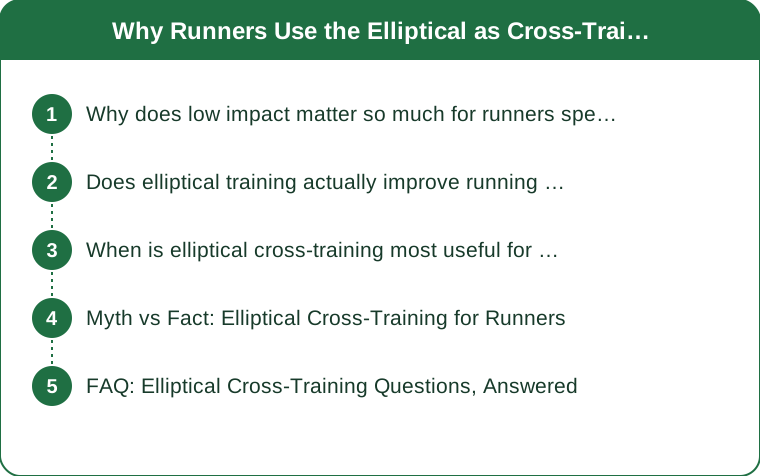
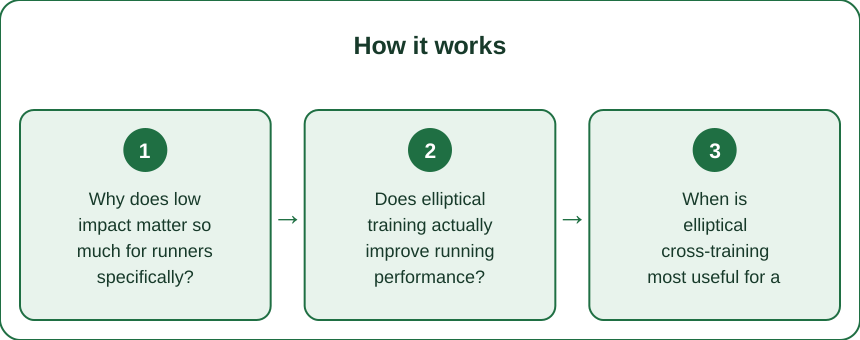
Why does low impact matter so much for runners specifically?
Running accumulates repetitive impact stress on joints and connective tissue over time, and that cumulative load is a common contributor to overuse injuries. The elliptical allows a runner to maintain cardiovascular fitness on recovery days or during injury rehab without adding to that impact load.
Does elliptical training actually improve running performance?
It maintains and supports cardiovascular fitness, but it doesn’t replicate running’s specific muscle recruitment patterns and impact adaptation, which are part of what makes a runner faster and more resilient at running specifically. It’s best understood as a complement, not a substitute for running-specific training.

When is elliptical cross-training most useful for a runner’s schedule?
During injury recovery, on designated easy or recovery days, or when adding aerobic volume without adding running mileage — all situations where a runner wants cardiovascular benefit without additional impact stress on already-loaded joints and tissue.
Myth vs Fact: Elliptical Cross-Training for Runners
Myth: elliptical training directly improves running speed and mechanics. Fact: it maintains general cardiovascular fitness but doesn’t train the specific muscle patterns and impact tolerance running requires. Myth: using the elliptical instead of running is always the safer choice. Fact: some impact loading is actually necessary for bone density and running-specific tissue adaptation — completely avoiding impact long-term isn’t automatically better.
FAQ: Elliptical Cross-Training Questions, Answered
How often should a healthy runner use the elliptical instead of running?
For uninjured runners, occasional use on recovery days or to add aerobic volume is reasonable, but most training plans still prioritize running itself for run-specific adaptation.
Is the elliptical a good option during return-to-running after an injury?
Often yes, since it allows cardiovascular maintenance during a period when running itself may be restricted — but return timelines should be guided by a physical therapist or doctor for anything beyond minor, self-limiting issues. This is general information, not medical advice.
Does using the arms on an elliptical make it a better runner substitute?
Using the arm handles adds upper-body engagement, but it still doesn’t replicate the specific lower-body mechanics and impact pattern of running — it adds general fitness value more than running-specific transfer.
TL;DR:
- The elliptical’s main value for runners is cardio conditioning with minimal impact stress
- It complements running (recovery days, injury rehab, extra volume) rather than replacing it
- It doesn’t train running-specific mechanics or impact tolerance
- Some impact loading is actually necessary for long-term running adaptation, so it’s not about avoiding impact entirely
Use the elliptical as a smart supplement to running, not a permanent substitute for it.
Keep Reading
This article is for general informational and styling purposes only. Fit, sizing, and product availability may vary.