Why the Elliptical's Calorie Count Is Probably Wrong (And by How Much)
Quick Answer: The number is high — and the elliptical is among the worst offenders of the common cardio machines. It uses generic inputs that can’t know your body composition, it can’t tell how hard you’re actually pushing the arm handles, and its assisted motion costs less energy than the algorithms tend to assume. Treat the display as a relative-effort tracker, not a calorie figure. If you need a real number, use a heart rate monitor and at minimum enter your actual weight into the console.
That “612 CALORIES” glowing at you after 40 minutes feels like a receipt.
It’s closer to an estimate written by someone who has never met you, doesn’t know how hard you’re pulling on the handles, and has a mild commercial interest in you feeling good about the machine.

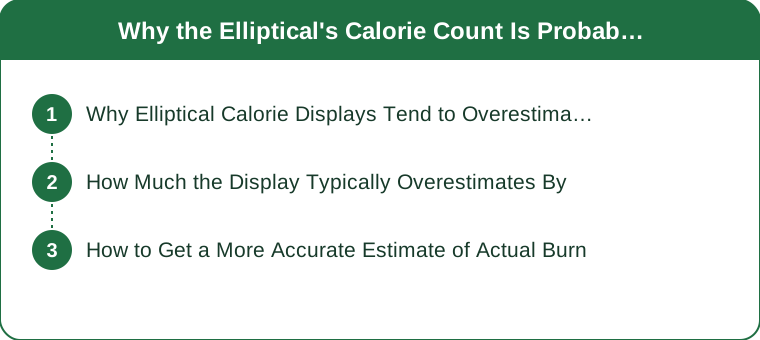
Why Do Ellipticals Overestimate More Than Other Machines?
It only knows generic inputs. The algorithm has your weight, maybe your age, and that’s roughly it. Two people at the same weight with different body compositions, fitness levels, and movement efficiency have genuinely different metabolic costs for identical work. Every cardio machine shares this limitation.
It can’t tell what your arms are doing. This one is elliptical-specific and it’s the big one. The handles are optional, and how much you actually drive with them varies enormously — from real upper-body effort to resting your hands there while your legs do everything. The calorie algorithm often doesn’t consistently account for that difference, so the same displayed number covers wildly different amounts of actual work.
Resistance settings can overstate the effort. A high resistance number doesn’t guarantee high physiological cost, particularly if you’re moving slowly through it. Certain resistance-and-incline combinations produce displayed figures well above what’s actually happening.
The assisted motion costs less than the algorithm assumes. This is the subtle one. The elliptical guides your feet through a fixed circular path. That means less stabilization work and less eccentric muscle loading than free movement like running requires. Some underlying calorie models were calibrated against more variable natural movement — so the machine’s guided path may simply cost less energy than the math expects.

How Far Off Is It, Roughly?
The honest answer: meaningfully high, and nobody can give you one universal correction factor.
Consumer cardio equipment across the board — treadmills, bikes, stair climbers, ellipticals — has repeatedly been reported to display calorie estimates running well above more carefully measured energy expenditure. That’s the general pattern, and it isn’t a small gap.
The elliptical-specific issues above give good reason to expect it sits toward the more inflated end of that general range rather than the better end. The arm-handle ambiguity alone introduces variation no generic algorithm can resolve.
What this gives you is a sense of scale, not a precise correction. Anyone quoting you an exact percentage is being more confident than the evidence supports. The useful takeaway is simpler: whatever the console says, the real figure is lower, and you shouldn’t build an eating plan on that number.
Myth vs Fact
Myth: The number is precise because the machine is measuring you. Fact: It’s measuring resistance and cadence, then running that through a formula built for a generic person. The only thing it knows about you is whatever you typed in — which for most people is nothing.
Myth: A more expensive machine gives a more accurate number. Fact: Better build quality doesn’t fix the underlying problem. The formula still can’t see your body composition or know what your arms are doing.
Myth: If I burn 600 on the machine, I can eat 600 more. Fact: This is where the inaccuracy actually costs you. Eating back an inflated number is one of the more common reasons cardio-heavy routines produce disappointing results. If you’re going to eat back exercise calories at all, discount the display substantially first.
How Do I Get a Better Number?
Use heart rate instead. A chest strap — or a reasonably accurate wrist monitor — reflects your individual physiological effort far more directly than a generic formula does. It’s not perfect either, but it’s individually calibrated in a way the console can never be.
Actually enter your details. Most people skip the setup screen and mash “quick start,” which leaves the machine assuming a default weight that may be nowhere near yours. Thirty seconds of input meaningfully improves the baseline. It’s the cheapest accuracy upgrade available and almost nobody does it.
Discount what’s on the screen. As a rough mental rule, treat the displayed figure as substantially inflated and adjust downward before you use it for anything. Imprecise, but much closer than face value.
Track relative effort instead of absolute calories. This is the one that actually matters. Same machine, same resistance, same duration — did you cover more distance this week than last? Was your average heart rate lower for the same output? Those comparisons are reliable even when the underlying calorie math isn’t, because the error is consistent across your own sessions. You’re using the machine as its own reference point, which is the one job it can genuinely do.
Mini FAQ
Which cardio machine has the most accurate calorie display?
Rowers and stationary bikes that display actual power output in watts tend to be the most defensible, because watts are a direct measurement rather than an inference. Treadmills do reasonably well for running without incline. Ellipticals are generally at the less reliable end.
Does holding the handles actually add much?
Actively driving through them adds real upper-body work — but it also means the machine’s number becomes even less predictable, since it can’t tell the difference between driving and resting. If you want the number to be more consistent session to session, pick one approach and stick to it.
Should I stop using the elliptical because of this?
No. The machine is a perfectly good low-impact cardio option, especially if your joints don’t love running. The calorie display being unreliable is an argument about the display, not the exercise.
TL;DR:
- Elliptical calorie displays run meaningfully high — likely toward the worse end for cardio machines.
- Causes: generic inputs, unmeasurable arm-handle effort, resistance overstating cost, assisted motion costing less than assumed.
- Don’t eat back the displayed number; discount it substantially first.
- Enter your real weight, and use a heart rate monitor if you want an individual estimate.
- Best use of the console: comparing your own sessions week to week, not counting calories.
Keep Reading
This article is for general informational and styling purposes only. Fit, sizing, and product availability may vary.